
Grading on a curve has been debated by teachers, students, and universities for decades. Some believe it creates a fairer learning environment by adjusting for difficult exams, while others argue that it can reward or penalize students based on how their classmates perform rather than their own knowledge.
The truth is that there isn’t a simple yes or no answer.
Whether grading on a curve is fair depends on several factors, including the type of grading method used, the difficulty of the exam, the overall class performance, and the institution’s grading policies.
In this guide, we’ll explore both sides of the debate, explain when curved grading makes sense, and discuss how educators can apply it fairly.
If you’d like to compare different grading methods yourself, you can use our free Grade Curve Calculator to see how different curves affect student scores.
Quick Answer
Grading on a curve can be fair when an exam is unusually difficult or doesn’t accurately measure student understanding. However, its fairness depends on the grading method, the performance of the class, and the instructor’s grading policy. A curve should improve fairness rather than artificially raise or lower grades.
What Does Grading on a Curve Mean?
Grading on a curve means adjusting students’ original exam scores using a mathematical method instead of relying only on raw marks.
Different curve methods produce different results.
For example, some methods add the same number of points to every student’s score, while others compare each student’s performance with the rest of the class.
Because there are several ways to curve grades, it’s important to understand that not every grading curve works the same way.
If you’d like to learn the basics first, read our guide on What Is a Grade Curve?.
Why Do Teachers Grade on a Curve?
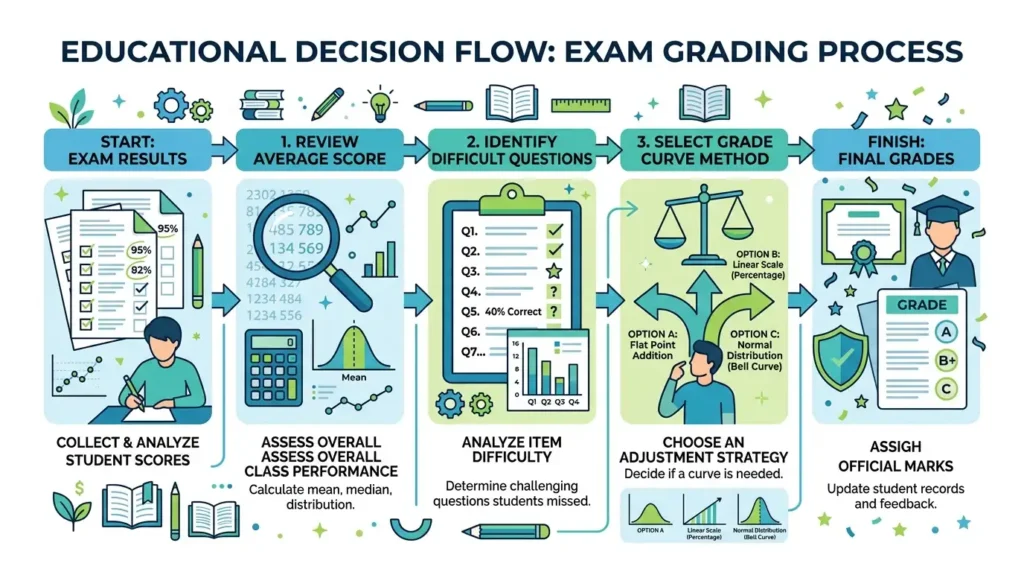
Teachers don’t usually curve grades simply to increase student scores.
Instead, they often use grade curves to correct situations where an assessment doesn’t accurately reflect student learning.
Some common reasons include:
The Exam Was More Difficult Than Expected
Even well-designed exams can sometimes be harder than intended.
If a large portion of the class performs poorly despite understanding the course material, a curve may create a fairer outcome.
The Class Average Is Unusually Low
A very low average score may suggest that the assessment was too challenging rather than indicating that every student failed to prepare.
Multiple Course Sections Need Consistent Grading
Universities often have several instructors teaching the same course.
If one section receives a more difficult exam than another, grade curves can help create consistent grading standards.
Maintaining Fairness
The primary goal of a grading curve should always be fairness, not simply increasing grades.
If you’re wondering when teachers should apply a grading curve, read When Should Teachers Curve Grades?.
Arguments in Favor of Grading on a Curve
Supporters of curved grading believe it offers several important advantages.
It Can Improve Fairness
When an exam is unexpectedly difficult, curving grades helps prevent students from being unfairly penalized.
It Reflects Overall Class Performance
Rather than evaluating students in isolation, curved grading considers how the entire class performed.
It Helps Standardize Grading
In large universities with multiple instructors, grade curves can make grading more consistent across different sections.
It Can Reduce the Impact of Difficult Questions
If several exam questions prove much harder than expected, a curve can lessen their influence on final grades.
Arguments Against Grading on a Curve
Although grade curves have benefits, they also have limitations.
It Can Create Competition
Some students dislike curved grading because their results may depend partly on how well other students perform.
Some Students May Receive Lower Relative Grades
Certain statistical grading methods compare students with one another rather than using fixed grading standards.
Not Every Class Fits a Bell Curve
Student scores don’t always follow a normal distribution.
Applying a Bell Curve when the data doesn’t support it may produce misleading results.
It Can Be Difficult to Understand
Students often find statistical grading methods confusing, especially if the instructor doesn’t explain how grades were adjusted.
Worked Example
Imagine a class of 40 students takes a final exam.
The instructor expected the class average to be around 75%, but after grading the exams, the average score is only 54%.
After reviewing the assessment, the teacher realizes that several questions were much more difficult than intended.
Instead of immediately adding five points to every student’s grade, the instructor compares different grading methods.
A Linear Curve would increase every student’s score equally.
A Bell Curve would adjust grades based on the overall distribution of scores.
The teacher chooses the method that best reflects student understanding while maintaining fairness.
This example shows that curved grading isn’t about giving away marks. It’s about selecting the most appropriate adjustment for the situation.
Bell Curve vs Linear Curve: Which Is Fairer?
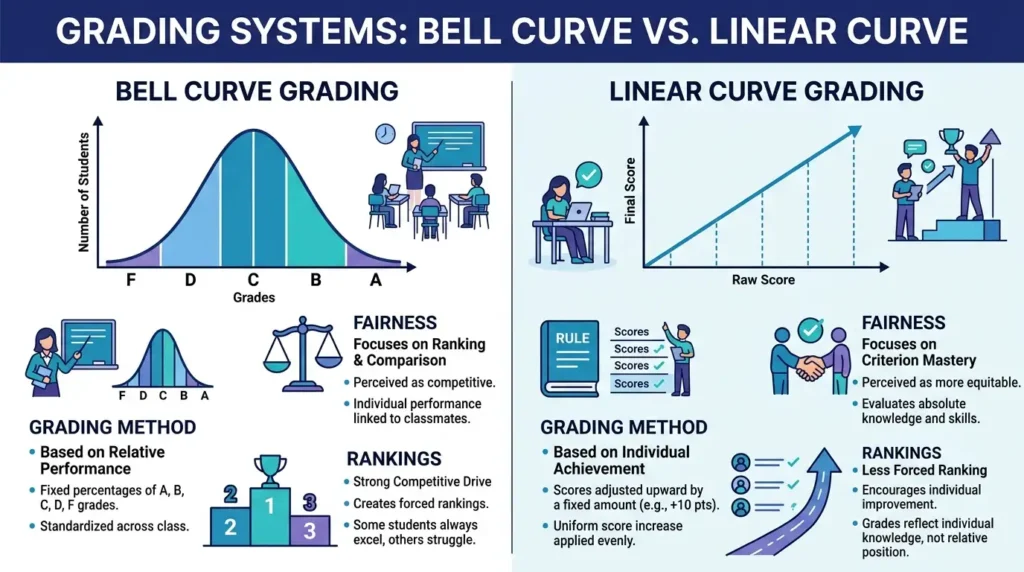
One of the biggest debates is whether a Bell Curve or a Linear Curve is fairer.
| Bell Curve | Linear Curve |
|---|---|
| Based on overall class performance | Adds the same points to every student |
| May change student rankings | Rankings remain the same |
| Uses statistical analysis | Uses simple arithmetic |
| Better for difficult exams | Better for small adjustments |
Neither method is always better.
The best choice depends on the assessment and the instructor’s grading objectives.
You can explore both methods in more detail by reading Bell Curve vs Linear Curve and Bell Curve Grading Explained.
Do Colleges Think Curved Grading Is Fair?
There isn’t a universal policy.
Some colleges encourage instructors to use grade curves when exams are unusually difficult.
Others prohibit curved grading entirely and require fixed grading scales.
Many universities leave the decision to individual departments or instructors.
This means students taking similar courses at different institutions may experience very different grading practices.
Learn more in Do Colleges Grade on a Curve?.
How Teachers Can Apply Grade Curves Fairly

If a teacher decides to curve grades, following a few best practices can improve transparency and fairness.
Review the Exam First
Before adjusting grades, determine whether the exam accurately measured student understanding.
Explain the Grading Policy
Students are more likely to trust the process when they understand how final grades are calculated.
Compare Different Curve Methods
Different situations may require different grading approaches.
For example, a Linear Curve may be appropriate for a slightly difficult exam, while a Bell Curve may better suit large university classes.
Follow Institutional Policies
Teachers should always ensure that any grading adjustments comply with school or university guidelines.
Use Reliable Calculation Tools
Whether you use spreadsheets or online tools, accurate calculations are essential.
If you prefer spreadsheets, our guides on How to Curve Grades in Excel and How to Curve Grades in Google Sheets provide step-by-step instructions.
If you want to compare multiple grading methods instantly, our Grade Curve Calculator can help simplify the process.
Frequently Asked Questions
No. Curved grading is only fair when it accurately addresses issues with the assessment and is applied consistently.
Some statistical grading methods can lower relative grades, although many instructors use curves only to improve fairness after difficult exams.
Some students feel that their grades should depend only on their own performance rather than the performance of the rest of the class.
There is no single answer. The fairest method depends on the exam, class performance, and institutional grading policies.
Yes. Explaining grading policies before or shortly after an assessment helps improve transparency and reduces confusion.
Final Thoughts
So, is grading on a curve fair?
The answer depends on how and why it is used.
A well-designed grading curve can improve fairness when an exam is unusually difficult or fails to reflect student understanding. However, using a curve without careful consideration may create confusion or unintended consequences.
The most effective approach is to evaluate each assessment individually, choose the grading method that best fits the situation, and communicate the process clearly to students.
If you’d like to compare different grading methods before making a decision, try our free Grade Curve Calculator. It allows you to explore multiple curve methods, compare results, and visualize grade distributions in just a few clicks.